
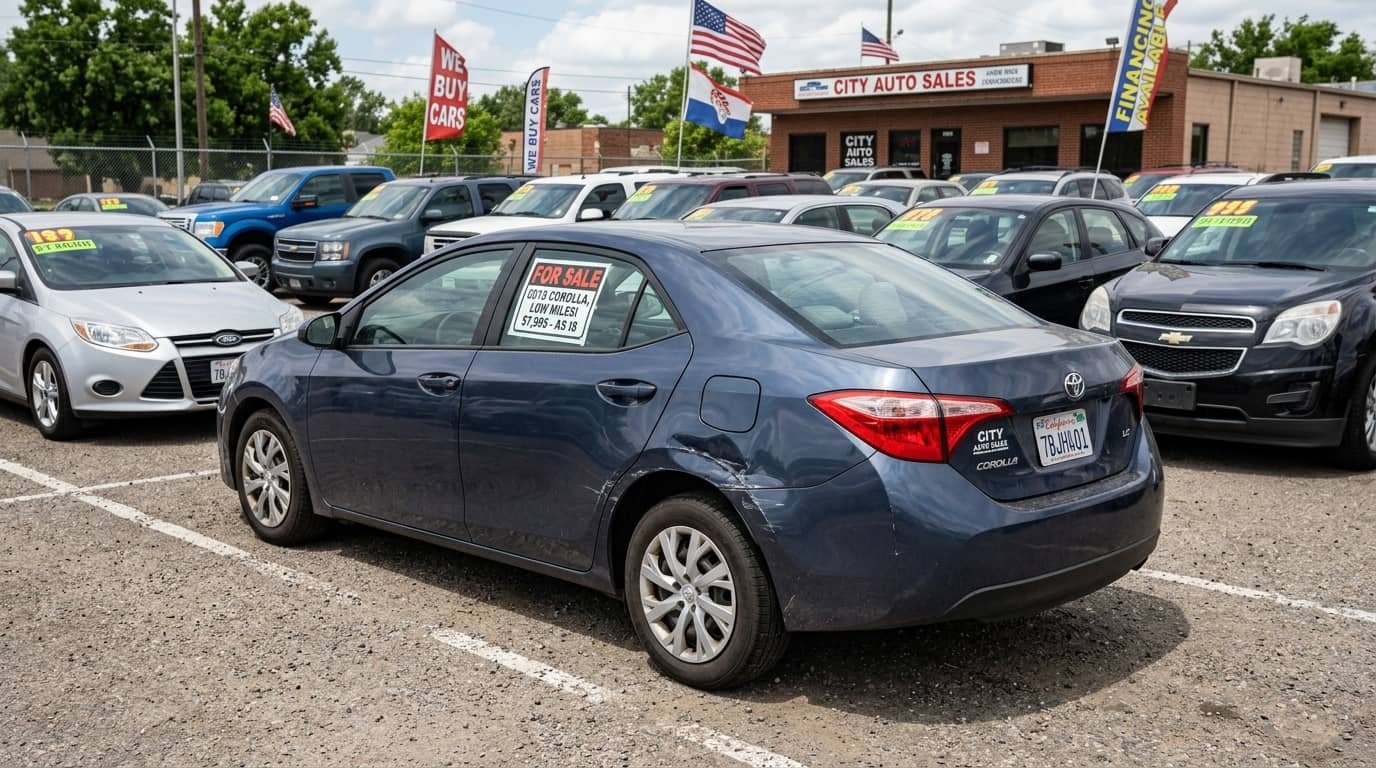
Should I buy a car with accident history? That depends entirely on what the history actually shows.
Not all accidents are equal, and not all accident histories mean walking away.
A minor fender bender that was properly repaired is very different from a car that was hit hard enough to bend the frame. The problem is that from the outside, both can look exactly the same.
That is why the question is not just “was this car in an accident” but “what happened, how bad was it, and how well was it fixed.”
Before you make any decision, pull the VIN report and see what the history actually shows. See what is on record for this vehicle and use that as your starting point.
Should You Buy a Car With Accident History? What the Report Actually Shows
When an accident shows up on a vehicle history report, it means the incident was reported to an insurance company, a repair shop that uses certain reporting systems, or a government database.
It does not tell you the full story on its own. The report may show the date, the type of damage, and whether airbags deployed, but it often does not tell you exactly what was repaired or how well.
It also does not show accidents that were never reported. A seller could have had a private repair done after a collision and it would not appear on the report at all. This is another reason to combine a VIN check with a physical inspection.
Minor Accidents vs. Serious Damage
A minor accident, such as a low-speed parking lot hit or a small rear-end bump, usually involves cosmetic repairs like bumpers, paint, and trim. If it was fixed properly, it typically does not affect how the car drives or how safe it is.
A serious accident is a different situation. When a car takes a hard enough hit, the frame or unibody structure can bend or crumple in ways that are difficult to fully restore. Even after repairs, the structural integrity may not be what it was. That matters in a future accident, when the car needs to protect you again.
Serious accidents also raise questions about whether the airbags deployed, whether the sensors and safety systems were properly replaced and recalibrated, and whether any hidden damage was left unaddressed.
What to Look For in the History Report
When you pull the VIN report on a car with accident history, pay attention to these things:
- How many reported incidents are there
- What type of damage was listed, such as front, rear, side, or rollover
- Whether airbags deployed
- Whether the vehicle was ever declared a total loss or given a salvage title
- Whether the mileage at the time of the accident matches the seller’s story
- How much time passed between the accident and when the car went back on the road
A car that was totaled and later rebuilt is a much bigger concern than one that had a bumper replaced after a low-speed hit.
Get an Independent Inspection
A vehicle history report tells you what was documented. A mechanic inspection tells you what is actually there.
For any car with a reported accident, especially one involving significant damage, pay for a pre-purchase inspection from a mechanic who has no connection to the seller. Ask them specifically to check for frame damage, signs of previous body repairs, uneven panel gaps, and anything that suggests the car was in a harder hit than what was disclosed.
Paint thickness gauges can also reveal areas that were repainted, which points to prior body work even if the panels look fine to the eye.
How Accident History Affects Value
Once an accident appears in the history report, it permanently affects what the car is worth. Even a minor accident can reduce value by 10 to 15 percent compared to a similar car with a clean history. Significant structural damage can cut value by 25 to 50 percent.
That price difference can work in your favor as a buyer, as long as you understand what you are actually getting. If the damage was genuinely minor and the repair was done right, a lower price can be a real opportunity.
If the damage was serious and the price is only slightly lower than a clean car, it is probably not worth it.
When to Walk Away
Some situations are straightforward reasons to pass on the car:
- The vehicle was declared a total loss at any point
- There is evidence of frame or structural damage
- Airbags deployed and the seller cannot show they were properly replaced and calibrated
- The seller cannot provide repair records for documented damage
- The accident history does not match what the seller told you
- Multiple reported accidents on the same vehicle
Any of those on their own is worth pausing. More than one of them together is a clear sign to move on.
The Bottom Line
Buying a car with accident history is not automatically a bad idea. It depends entirely on what happened and how it was handled.
What you should never do is make that decision without the full picture. Check the VIN, read the report carefully, and get a mechanic to look at the car in person before you decide.
Run the VIN and check the accident history before you go any further with this vehicle.
Frequently asked questions
Does all accident history make a car a bad buy?
No. A minor fender bender with no structural involvement, properly repaired and documented, is very different from a major collision with frame damage or airbag deployment. What matters is the severity of the impact, what was damaged, and the quality of the repair. A vehicle history report shows the reported accident events. A pre-purchase mechanic inspection shows whether the repairs were done correctly.
Can a car be safe to drive after a major accident?
It depends entirely on what was damaged and how well it was repaired. A car with a repaired frame can be structurally sound if the repair was done properly at a qualified shop. However, there is no way to verify repair quality from the outside alone. A mechanic inspection on a lift is the only way to assess frame condition, suspension integrity, and whether any prior damage affects the car’s safety.
Will accident history affect a car’s resale value?
Yes. Any reported accident appears on the vehicle history report that future buyers will run. Minor accidents with no structural involvement cause a smaller value reduction than major ones. Accidents involving airbag deployment or frame damage cause significant reductions because buyers and lenders treat those as higher risk. When buying a car with accident history, factor the reduced future resale value into your decision.