
If you asked and the seller won’t give VIN number, trust that feeling in your gut.
A legitimate seller has no reason to hide the VIN. It is not private information. It is not sensitive. It is printed on the windshield, stamped on the door frame, and listed on the title. Any honest person selling a car will give it to you without hesitation.
When someone won’t share it, something is usually wrong.
Before you go any further with this seller, run the VIN yourself if you can get it. See what’s on record for the vehicle and compare it to what the seller is telling you.
What the VIN Actually Is
The VIN is a 17-character code that is unique to every vehicle. Think of it as the car’s fingerprint.
It records the vehicle’s history across its lifetime, including title changes, reported accidents, odometer readings, recalls, and more. That history is exactly what buyers need to see before handing over money.
There is nothing in a VIN that can be used against a seller. It cannot be used to steal the car. It cannot be used to access personal information. Sellers who understand this share it freely.
What to Do When a Seller Won’t Give VIN Information
If the seller won’t tell you, you may still be able to get it yourself.
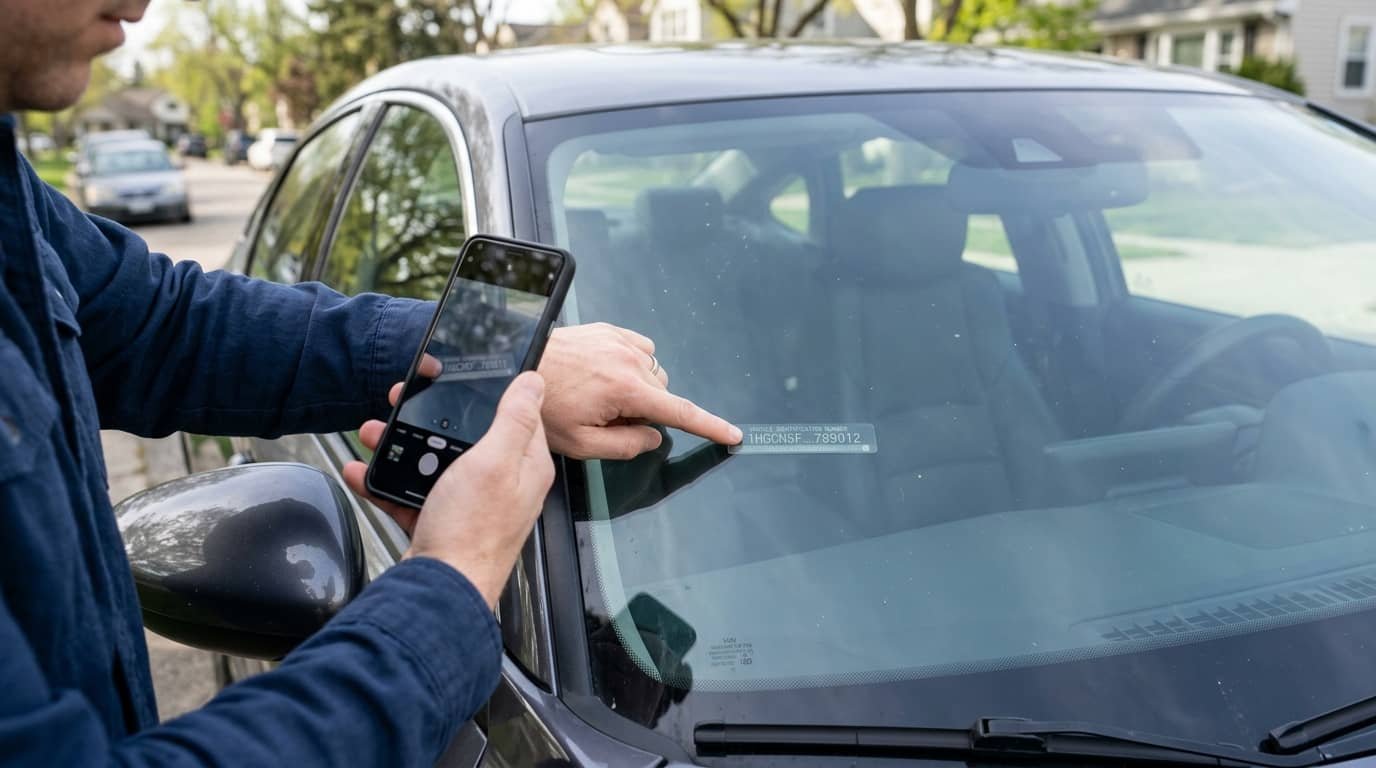
On any vehicle, the VIN appears in at least a few places:
- On the dashboard, visible through the windshield on the driver’s side
- On a sticker inside the driver’s side door jamb
- On the engine block under the hood
- On the vehicle title and registration documents
- On the insurance card
If you can see the car in person, you can get the VIN yourself just by looking. You do not need the seller to hand it to you.
The problem is when a seller refuses to let you see the car, refuses to meet in person, or is only communicating remotely. That is where things get more serious.
Reasons a Seller Might Refuse, and What They Usually Mean
They are hiding the vehicle history.
This is the most common reason. The car may have a salvage title, flood damage, reported accidents, an odometer that was tampered with, or a title brand that would drop the price significantly. A VIN check would show all of that. Refusing to share the VIN keeps you from finding out.
The car may be stolen.
Stolen vehicles sometimes get sold quickly at a low price through private channels. A stolen car’s VIN will often come back with a flag in the history records. A seller moving a stolen vehicle has every reason to avoid that check.
The listing may be a scam.
Online car scams are common. A fake listing might use photos of a real car but with a different VIN, or no VIN at all. If a seller is pushing you to pay without letting you verify the vehicle, that is a scam setup.
They claim privacy concerns.
Some sellers genuinely believe sharing the VIN is risky. It is not, but the concern exists. If this is the reason, a quick explanation usually fixes it. A seller who is honest will come around once they understand the VIN reveals nothing personal. If explaining does not help and they still refuse, that tells you something.
What to Do When a Seller Won’t Give You the VIN
Ask once more and explain why you need it.
Some sellers are just unfamiliar with the process. Tell them you want to run a vehicle history check before committing, which is a completely normal part of buying a used car. A good seller will understand.
Try to see the car in person.
If the deal is local, ask to meet at the vehicle. You can get the VIN from the windshield yourself and run the check on the spot. A seller who refuses an in-person meeting before payment is a much bigger red flag than one who is just slow to respond.
Do not send any money.
No deposit, no wire transfer, no Zelle, no nothing. Not until you have the VIN, run the check, and are satisfied with what it shows. Once the money is gone, it is very hard to get back.
Walk away.
If the seller keeps stalling, making excuses, or pressuring you to move fast without the VIN, the right move is to leave. There are other cars. There are not unlimited chances to recover from a bad purchase.
What a VIN Check Can Show You
If you do get the VIN, here is what a vehicle history report can pull up:
- Title history, including salvage, rebuilt, flood, or lemon law brands
- Reported accidents and damage events
- Odometer readings over time
- Number of previous owners
- Whether the vehicle has any open recalls
- State emissions and inspection records (where reported)
- Theft records
This is the information that tells you whether the seller’s story matches the car’s actual record. A seller who hides the VIN is a seller who does not want you to make that comparison.
Check the VIN before you commit and see what the vehicle history shows.
The Bottom Line
A seller who won’t give you the VIN is not doing you a favor by keeping it back.
Either they are hiding something, they are running a scam, or they do not understand how car sales work. In any of those cases, you should not be handing over money.
The VIN check is one of the simplest things a buyer can do. It takes a few minutes and can save you from buying a car with a hidden title problem, undisclosed accident damage, or a rolled-back odometer.
If a seller makes that simple step impossible, the answer is no.
Frequently asked questions
Is it a red flag if a seller won’t give you the VIN?
Yes. The VIN is printed on the dashboard of every car built since 1981 and is visible through the windshield. There is no legitimate reason to withhold it. A seller who refuses to share the VIN before you show up is preventing you from running a history check in advance. That is almost always intentional.
Can you look up a VIN without the seller’s help?
If you can see the car in person, the VIN is on the dashboard visible through the windshield on the driver’s side, and on a sticker inside the driver’s door jamb. It is also on the title and registration. You do not need the seller to hand it to you if you can physically see the car.
What should you do if a seller refuses to give you the VIN before showing up?
Do not go. Tell the seller you run a VIN check before meeting on any car and you are happy to proceed once they share it. A seller with a clean car will share it. One who refuses is making your decision for you. Move on to the next listing.